
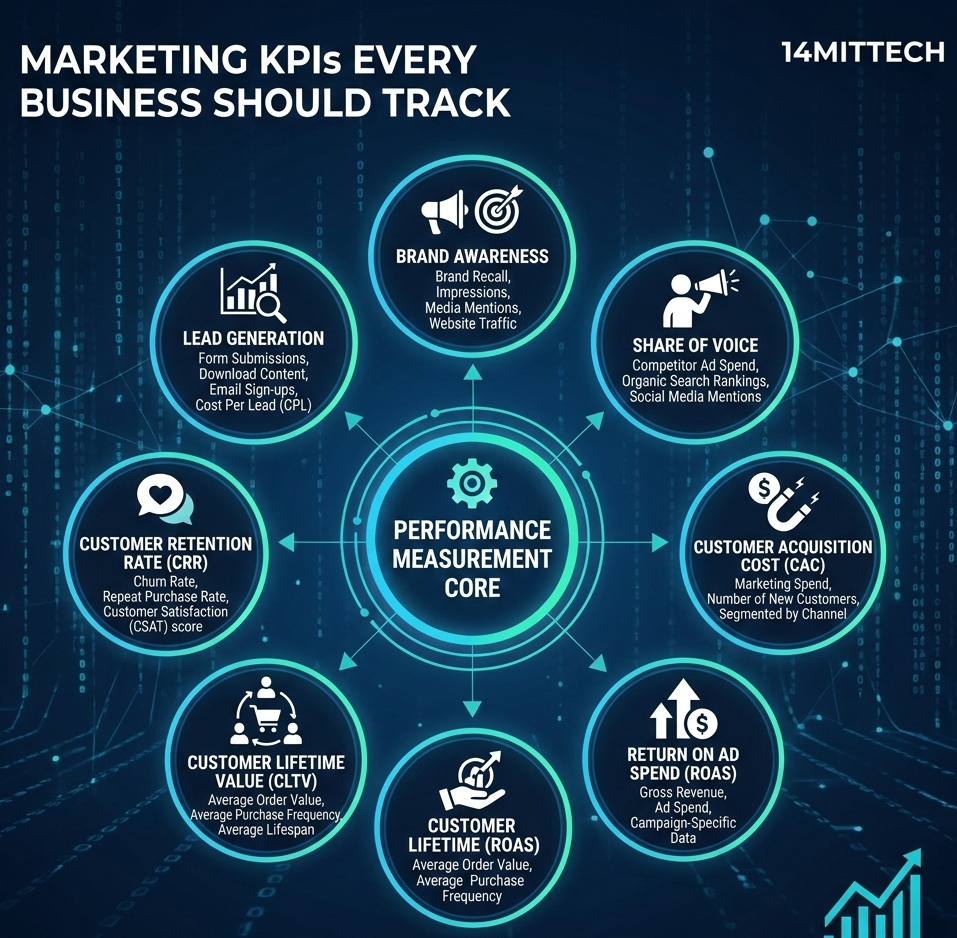
Why Marketing KPIs Matter More Than Ever
Understanding marketing KPIs every business should track is essential for sustainable growth in 2026. Marketing today is no longer based on assumptions or creative intuition alone. It is driven by measurable performance indicators that reveal what is working, what needs improvement, and where budgets should be allocated. Without clear Key Performance Indicators (KPIs), businesses risk spending money on campaigns that generate visibility but fail to produce meaningful results.
KPIs help translate marketing efforts into business outcomes such as revenue growth, lead generation, and customer retention. Whether you are running paid ads, SEO campaigns, social media strategies, or email marketing, tracking the right metrics ensures that every effort aligns with overall business goals. Data-driven decision-making has become a competitive advantage, allowing companies to scale confidently and optimize campaigns in real time.
1. Website Traffic and User Behavior Metrics
Website performance remains one of the most important areas to monitor. Traffic volume indicates how many users are visiting your site, but deeper behavioral metrics provide more meaningful insights. Metrics such as average session duration, bounce rate, and pages per session reveal how engaged visitors are once they arrive.
For example, a high traffic volume with a high bounce rate may indicate that your content or landing pages are not aligned with user expectations. On the other hand, longer session durations often signal strong content relevance and effective user experience. Tracking these metrics consistently allows businesses to refine website structure, messaging, and conversion pathways for better results.
2. Lead Generation and Conversion Rate
Lead generation KPIs directly impact revenue growth. Tracking the number of leads generated from various channels helps businesses understand which platforms are most effective. However, lead quantity alone is not enough. Conversion rate is a critical KPI that measures how many visitors or leads complete a desired action, such as filling out a form, booking a consultation, or making a purchase.
A strong conversion rate reflects effective messaging, clear calls-to-action, and well-optimized landing pages. Monitoring conversion trends over time also helps identify seasonal shifts or campaign performance fluctuations. When businesses focus on improving conversion rates rather than just increasing traffic, marketing efforts become more cost-efficient and results-driven.
3. Customer Acquisition and Conversion KPIs
Generating leads is only part of the process. Converting those leads into paying customers is what ultimately drives profitability. Customer acquisition cost (CAC) measures the total cost required to acquire a new customer, including marketing and sales expenses. Comparing CAC with customer lifetime value (CLV) helps determine long-term sustainability.
Conversion rate is another crucial metric. It reflects how effectively your website, ads, or sales funnel persuade prospects to take action. Even small improvements in conversion rate can significantly impact revenue over time. Tracking these KPIs allows businesses to identify bottlenecks in the buyer journey and implement targeted improvements that enhance performance. So, marketing KPIs every business should track.
4. Engagement and Brand Awareness KPIs
Brand awareness and engagement metrics reveal how audiences interact with your content and campaigns. While impressions and reach indicate visibility, engagement rate provides deeper insight into how compelling your messaging is. High engagement often signals strong audience alignment and brand relevance.
Metrics such as social shares, comments, video watch time, and email open rates help measure audience interest and trust. These indicators are especially valuable for long-term brand positioning. Companies that prioritize engagement-based KPIs tend to build stronger relationships with their audiences, which ultimately improves customer loyalty and advocacy.
Professional digital marketing teams, including 14mittech, often focus on balancing visibility metrics with engagement metrics to ensure campaigns are not just reaching people but genuinely influencing them.
5. Revenue and ROI KPIs
At the end of the day, marketing must contribute to revenue. Return on investment (ROI) is one of the most important marketing KPIs every business should track because it directly measures profitability. Calculating ROI involves comparing campaign revenue against total marketing costs.
Return on ad spend (ROAS) is particularly relevant for paid advertising campaigns. It evaluates how much revenue is generated for every dollar spent on ads. Tracking revenue attribution across channels also helps identify which platforms are driving the most valuable conversions.
When businesses consistently monitor ROI and revenue-based KPIs, they can allocate budgets more effectively and scale high-performing campaigns with confidence.
6. Retention and Customer Loyalty KPIs
Acquiring new customers is often more expensive than retaining existing ones. That is why retention metrics are critical for long-term growth. Customer retention rate indicates how well your business maintains relationships over time. A high retention rate suggests strong customer satisfaction and brand loyalty.
Churn rate, on the other hand, measures how many customers stop doing business with you during a specific period. Identifying the reasons behind churn can help improve product offerings, service quality, or communication strategies.
Customer lifetime value (CLV) ties retention and revenue together by estimating the total value a customer brings throughout their relationship with your brand. Businesses that prioritize retention KPIs often achieve more predictable and sustainable marketing KPIs every business should track.
FAQs:
1. What are the most important marketing KPIs every business should track?
The most important KPIs include lead generation metrics, customer acquisition cost, conversion rate, return on investment, and customer lifetime value. These indicators help businesses measure performance across the entire marketing funnel and connect campaigns directly to revenue outcomes.
2. How often should marketing KPIs be reviewed?
Marketing KPIs should be reviewed weekly for active campaigns and monthly for overall strategic performance. Regular analysis allows businesses to identify trends early, adjust budgets, and optimize underperforming channels before they impact revenue.
3. Why is ROI considered the most critical marketing KPI?
ROI measures the profitability of marketing efforts by comparing revenue generated against total campaign costs. Without tracking ROI, businesses cannot determine whether their marketing investments are delivering sustainable returns.
4. What is the difference between vanity metrics and actionable KPIs?
Vanity metrics, such as impressions or follower counts, indicate visibility but may not directly impact revenue. Actionable KPIs, like conversion rate, cost per lead, and customer acquisition cost, provide measurable insights that guide strategic decisions.
5. Can small businesses benefit from tracking marketing KPIs?
Yes, small businesses often benefit the most because KPIs help them allocate limited budgets efficiently. By focusing on measurable results, they can compete strategically without overspending.
Data-Driven Marketing Creates Sustainable Growth
Tracking marketing KPIs every business should track is not just about collecting numbers; it is about gaining actionable insights that drive smarter decisions. From lead generation and customer acquisition to engagement and retention, each KPI provides a piece of the overall growth puzzle.
When businesses align their marketing efforts with measurable performance indicators, they reduce waste, improve efficiency, and increase profitability. Strategic analysis combined with consistent optimization leads to long-term success. By adopting a structured, performance-focused approach similar to frameworks implemented by agencies like 14mittech, businesses can transform marketing from an expense into a scalable growth engine.