
Why an On-Page SEO Checklist Is Essential
A well-planned on-page SEO checklist for higher Google rankings is one of the most important components of a successful digital marketing strategy. Search engines analyze hundreds of signals when deciding how webpages should rank in search results, and many of these signals come directly from on-page elements. From keyword placement and content structure to internal links and page performance, every element on a page contributes to how search engines interpret its relevance and value.
Search engines such as Google continuously update their algorithms to deliver the most useful results to users. Because of this, websites must ensure that their pages are optimized not only for search engines but also for real users who are searching for answers, solutions, or information. On-page SEO focuses on optimizing the elements that you can directly control within your website, ensuring that each page clearly communicates its purpose and delivers valuable content.
Another important aspect of on-page SEO is improving the user experience. Search engines increasingly evaluate how visitors interact with a page, including how long they stay, how easily they navigate, and whether they find the information they need. Pages that provide helpful, well-structured content tend to perform better in search results because they meet user expectations more effectively.
Businesses that follow a consistent optimization process often see steady improvements in search visibility and organic traffic. Digital marketing experts, including the team at 14mittech, often emphasize that a structured SEO checklist helps website owners avoid missing critical optimization steps. Instead of guessing what might improve rankings, marketers can systematically evaluate and enhance each element on their webpages.
By following a detailed on-page SEO checklist for higher Google rankings, businesses can create pages that are both search-engine-friendly and user-focused, leading to stronger long-term growth in organic search performance.
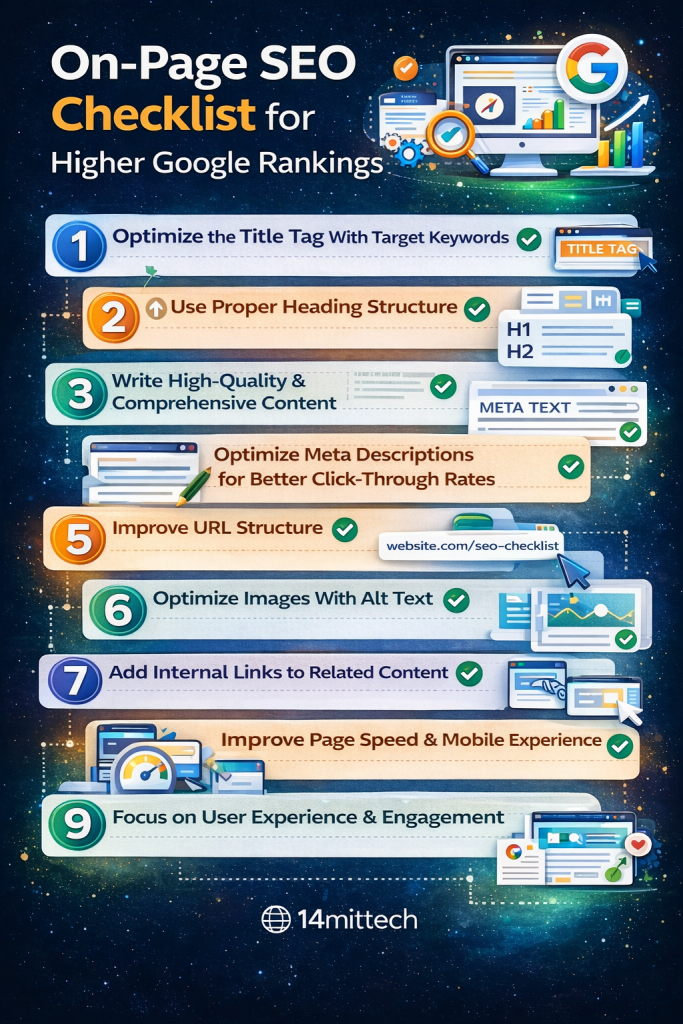
1. Optimize the Title Tag With Target Keywords
The title tag is one of the most powerful on-page SEO elements because it directly communicates the main topic of the page to both users and search engines. When people search for information online, the title tag is often the first thing they see in search results. A well-crafted title can therefore influence both rankings and click-through rates.
A good title tag should clearly describe the content of the page while including the target keyword in a natural way. Placing the primary keyword toward the beginning of the title can help search engines quickly understand the page topic. However, readability should always remain a priority because the title also needs to attract human readers.
Titles that include numbers, strong descriptive language, or clear benefits often perform better in search results because they stand out among other listings. For example, a title that promises actionable insights or practical strategies may encourage more users to click on the result.
It is also important to keep title tags within the recommended character length so they appear correctly in search results. Titles that are too long may be truncated, reducing their effectiveness. When optimized correctly, the title tag becomes a critical element in improving both search rankings and user engagement. So, on-page SEO checklist for higher Google rankings.
2. Use Proper Heading Structure
Headings play an essential role in organizing webpage content and making it easier for readers to understand. A clear heading structure helps break the content into logical sections, allowing users to quickly scan the page and locate the information they need.
From an SEO perspective, headings also help search engines understand the hierarchy of information within a page. The H1 tag usually represents the main topic, while H2 and H3 tags are used for subtopics and supporting details. When headings are structured properly, search engines can better interpret the relationships between different sections of the content.
Including relevant keywords naturally within headings can strengthen the topical relevance of the page. However, keywords should always be used naturally and not forced into headings where they do not fit. A well-structured article improves both readability and SEO performance, making it easier for both users and search engines to navigate the content. So, on-page SEO checklist for higher Google rankings.
3. Write High-Quality and Comprehensive Content
Content quality is one of the most significant ranking factors in modern search engine optimization. Search engines aim to provide users with the most accurate, helpful, and comprehensive answers to their queries. As a result, pages that provide detailed and valuable information are more likely to rank well.
High-quality content should address the topic thoroughly while remaining clear and easy to understand. Rather than writing short articles with limited information, it is often more effective to create in-depth resources that fully explore the subject. Comprehensive articles provide readers with multiple insights, examples, and explanations that help them understand the topic better.
Another benefit of detailed content is that it tends to attract backlinks from other websites. When a page becomes a trusted resource within its industry, other websites are more likely to reference it as a source of information. These backlinks further strengthen the page’s authority and search rankings.
Professional digital marketing teams, including 14mittech, often prioritize informative content because it not only improves rankings but also builds long-term trust with audiences. When users consistently find valuable information on a website, they are more likely to return in the future and share the content with others.
4. Optimize Meta Descriptions for Better Click-Through Rates
The meta description is a short summary that appears below the title in search results. Although it does not directly affect search rankings, it plays a crucial role in influencing whether users choose to click on a page.
A compelling meta description should clearly explain what the page offers while encouraging users to learn more. Including the target keyword naturally within the description can make it more relevant to search queries and help it stand out in search results.
Effective meta descriptions often highlight the main benefits of the content or promise useful insights that readers can gain by visiting the page. Keeping the description concise and informative ensures that it appears properly within search results without being cut off.
When optimized carefully, the meta description can significantly improve the click-through rate of a page, which in turn may contribute to better overall search performance. So, on-page SEO checklist for higher Google rankings.
5. Improve URL Structure
A well-optimized URL structure helps both users and search engines understand the topic of a webpage. Clear, concise URLs that include relevant keywords provide valuable context about the content before the page is even opened.
Short URLs are generally preferred because they are easier to read, share, and remember. Avoiding unnecessary numbers, symbols, or long strings of text helps keep the URL clean and user-friendly.
Including the primary keyword within the URL can also strengthen the relevance of the page for that topic. When search engines see consistent signals from the title, headings, and URL, they can more confidently understand what the page is about.
6. Optimize Images With Alt Text
Images enhance the visual appeal of content and make it easier for readers to engage with the information presented. However, search engines cannot interpret images in the same way humans do, which is why image optimization is important.
Alt text provides a description of the image that helps search engines understand its content and context. This description also improves accessibility for users who rely on screen readers.
Including relevant keywords naturally in the alt text can support overall on-page SEO while increasing the chances of the image appearing in search results. Properly optimized images therefore contribute both to better user experience and improved search visibility. So, on-page SEO checklist for higher Google rankings.
7. Add Internal Links to Related Content
Internal linking is an important SEO strategy that connects related pages within a website. When pages link to each other logically, search engines can discover and index them more easily.
Internal links also guide readers to additional information that may be relevant to their interests. For example, a reader exploring an SEO guide may benefit from links to related articles on keyword research or technical optimization.
By creating a network of interconnected pages, websites can distribute authority more effectively and improve the visibility of multiple pieces of content.
8. Improve Page Speed and Mobile Experience
Page speed is a crucial factor in both user experience and search engine rankings. Modern users expect websites to load quickly, and slow-loading pages often lead to higher bounce rates.
Optimizing images, minimizing unnecessary scripts, and using efficient hosting solutions can significantly improve page performance. Faster websites provide a better experience for visitors and are more likely to retain users for longer periods.
Mobile optimization is equally important because a large portion of online searches now occur on mobile devices. Ensuring that pages display correctly on smaller screens helps maintain accessibility and usability for all users. So, on-page SEO checklist for higher Google rankings.
9. Focus on User Experience and Engagement
User experience has become increasingly important in modern SEO strategies. Search engines analyze how users interact with webpages to determine whether the content is helpful and relevant.
Factors such as readability, navigation, and visual design all influence how users engage with a page. Clear formatting, well-organized sections, and easy navigation encourage visitors to stay longer and explore additional content.
Pages that provide a positive user experience tend to perform better in search rankings because they demonstrate value to visitors.
FAQs:
1. What is an on-page SEO checklist for higher Google rankings?
It is a structured guide that helps optimize webpage elements such as titles, headings, content, and links to improve visibility in search results.
2. Why is on-page SEO important?
On-page SEO helps search engines understand the relevance and quality of a webpage, which influences how it ranks in search results.
3. How long does it take to see results from on-page SEO?
Results can vary depending on competition and website authority, but improvements in rankings often appear within a few weeks or months after optimization.
4. Can on-page SEO increase website traffic?
Yes. When webpages are optimized correctly, they become more visible in search results, leading to increased organic traffic.
5. What are the most important on-page SEO factors?
Key factors include title tags, high-quality content, internal linking, image optimization, page speed, and user experience.
Building Strong Rankings With an On-Page SEO Checklist
Following a structured on-page SEO checklist for higher Google rankings helps businesses ensure that every element of their webpages is optimized effectively. From title tags and headings to page speed and internal links, each step contributes to stronger search visibility.
When websites consistently apply these optimization techniques, they create content that is easier for search engines to understand and more valuable for users. Over time, this leads to improved rankings, higher organic traffic, and stronger online authority.
By focusing on both technical optimization and user experience, businesses can build a sustainable SEO strategy that delivers long-term results.