
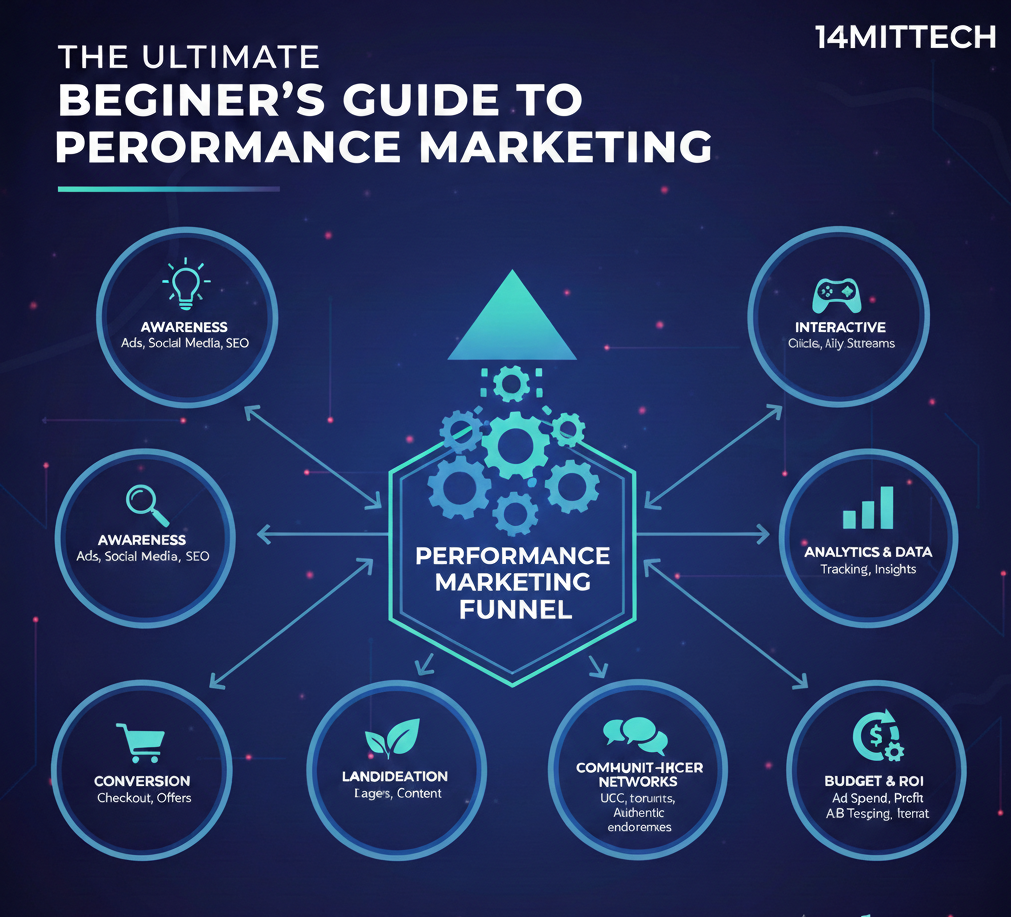
Understanding Performance Marketing in the Digital Era
Performance marketing has become one of the most powerful and measurable forms of digital advertising in recent years. Unlike traditional marketing, where businesses pay upfront for exposure without guaranteed results, performance marketing focuses on paying only for specific actions such as clicks, leads, or sales. In today’s competitive digital ecosystem, this results-driven approach allows brands to track every rupee spent and directly measure return on investment. So, Beginner’s Guide to Performance Marketing.
Platforms like Google Ads, Meta Ads, and LinkedIn Ads provide advanced targeting options, analytics dashboards, and conversion tracking systems that make performance marketing accessible even for beginners. Agencies such as 14mittech digital marketing agency help businesses design structured campaigns that focus on measurable growth instead of vanity metrics. This guide will walk you through the fundamentals of performance marketing, helping you understand how it works, why it matters, and how to get started effectively.
1. What Is Performance Marketing and How Does It Work?
Performance marketing is a digital strategy where advertisers pay only when a predefined action occurs. These actions can include website clicks, lead form submissions, app installs, or completed purchases. Instead of paying for impressions alone, businesses invest in outcomes that directly impact revenue.
For example, when running campaigns through Google Ads, advertisers can optimize for conversions rather than just traffic. Similarly, advertising on Facebook and Instagram allows businesses to track cost per click, cost per lead, and return on ad spend. This transparency enables continuous optimization.
At 14mittech, performance marketing campaigns are built around clear objectives, defined target audiences, and measurable KPIs to ensure every campaign aligns with business goals.
2. Key Channels Used in Performance Marketing
Performance marketing spans multiple digital channels, each serving a unique purpose within the marketing funnel. Search engine advertising captures high-intent users who are actively searching for solutions. Social media advertising helps build awareness and retarget potential customers. Affiliate marketing expands reach through partner networks, while display advertising increases brand visibility.
Platforms like Google enable search and display campaigns, while YouTube allows video-based performance ads that drive engagement and conversions. Choosing the right channel depends on your target audience, budget, and campaign objective. It is Beginner’s Guide to Performance Marketing.
A strategic mix of these channels ensures maximum reach and better conversion opportunities, especially when campaigns are monitored and optimized regularly.
3. Setting Up Your First Performance Marketing Campaign
Launching your first performance marketing campaign requires careful planning. The process begins with defining your goal, whether it is generating leads, increasing sales, or driving website traffic. Next, you must identify your target audience based on demographics, interests, behaviors, and search intent.
Budget allocation plays a crucial role in campaign success. Beginners should start with a controlled budget to test different creatives and audience segments. Once performance data is collected, you can scale high-performing ads and pause underperforming ones.
Conversion tracking tools are essential. Platforms like Google Analytics help monitor user behavior and measure campaign impact. Without proper tracking, it becomes difficult to calculate return on investment accurately.
4. Understanding Important Performance Metrics
To succeed in performance marketing, beginners must understand core metrics. Cost per click measures how much you pay for each click. Cost per acquisition indicates how much it costs to acquire a customer. Click through rate shows how effective your ad creative is in attracting attention. Return on ad spend measures profitability.
These metrics provide actionable insights that help optimize campaigns. For example, a low click through rate may indicate weak ad copy or poor targeting. A high cost per acquisition might signal the need for landing page improvements.
Performance marketing is data driven, meaning decisions are based on numbers rather than assumptions. Regular monitoring and adjustments ensure campaigns remain profitable. That makes Beginner’s Guide to Performance Marketing.
5. Optimization Strategies for Long Term Success
Successful performance marketing is not about launching ads once and waiting for results. It requires ongoing testing and refinement. A/B testing different headlines, images, calls to action, and audience segments can significantly improve performance.
Retargeting is another powerful strategy. Users who visit your website but do not convert can be re-engaged with personalized ads. Platforms like Meta Ads provide retargeting features that increase conversion rates by targeting warm audiences.
Landing page optimization is equally important. Even the best ad campaign will fail if the landing page does not clearly communicate value or provide a seamless user experience. Performance marketing works best when ads, messaging, and landing pages are aligned.
FAQs:
1. Is performance marketing suitable for beginners?
Yes. Performance marketing is beginner friendly because results are measurable. Platforms provide dashboards and analytics tools that help new marketers understand what works and what does not.
2. How much budget is required to start performance marketing?
There is no fixed amount. Beginners can start with a small test budget and gradually increase spending based on performance data.
3. How long does it take to see results?
Results can appear within days, especially with search ads targeting high intent keywords. However, long term optimization is necessary for sustainable growth.
4. What makes performance marketing different from traditional marketing?
The main difference is measurability. Traditional marketing focuses on exposure, while performance marketing focuses on specific, trackable outcomes.
Building a Results Driven Marketing Foundation
Performance marketing empowers businesses to spend smarter and grow faster. By focusing on measurable outcomes, brands can optimize campaigns, reduce waste, and increase profitability. For beginners, understanding the fundamentals of targeting, tracking, and optimization is the first step toward success.
With structured planning, continuous testing, and data analysis, performance marketing becomes a scalable growth engine. Businesses that embrace this results-oriented approach will build stronger digital presence and achieve consistent returns in the evolving online marketplace.